Biomechanical Feedback Loops: Motion Capture Tech Refining Tennis Serves and NFL Quarterback Throws
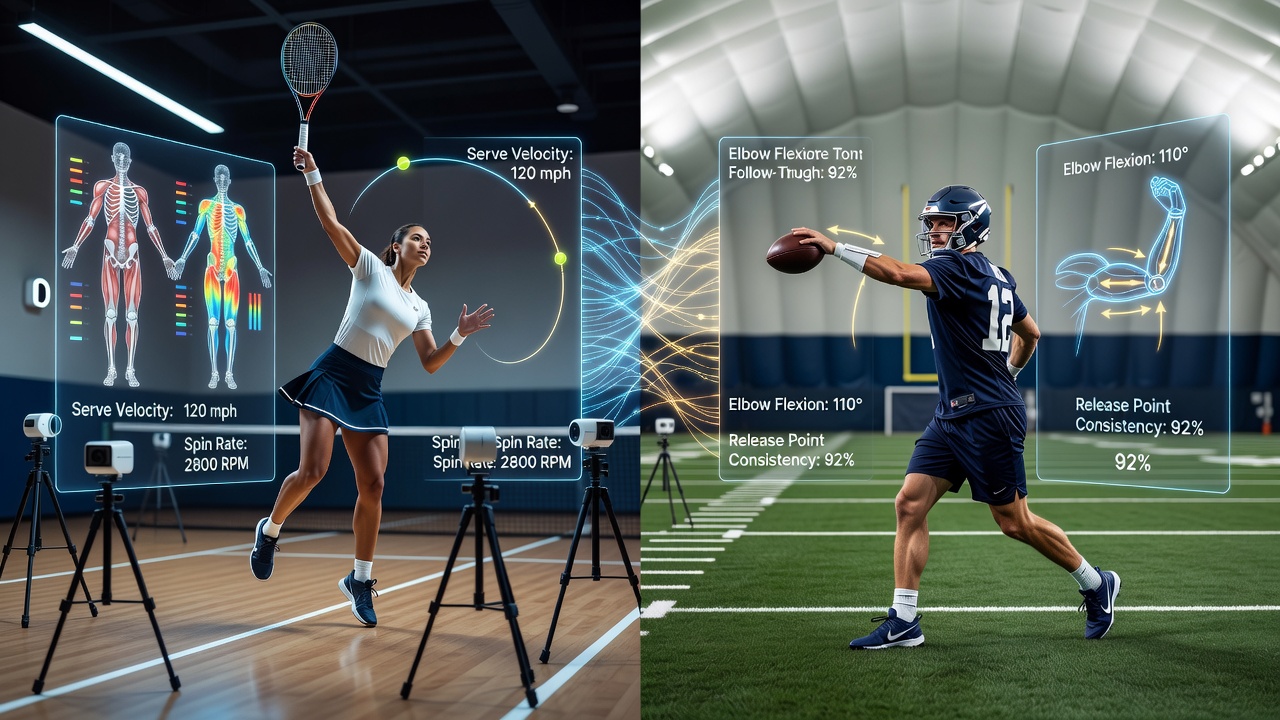
Professional athletes across different sports now rely on motion capture systems that track joint angles, velocity profiles, and force distribution during high-speed movements, and these tools create closed feedback loops that help refine technique over repeated sessions. Tennis players have adopted such systems to stabilize serve mechanics, while NFL teams apply similar data streams to quarterback throwing patterns because the underlying kinematic principles overlap in shoulder rotation, trunk torque, and wrist snap timing.
Tracking Serve Mechanics in Tennis Academies
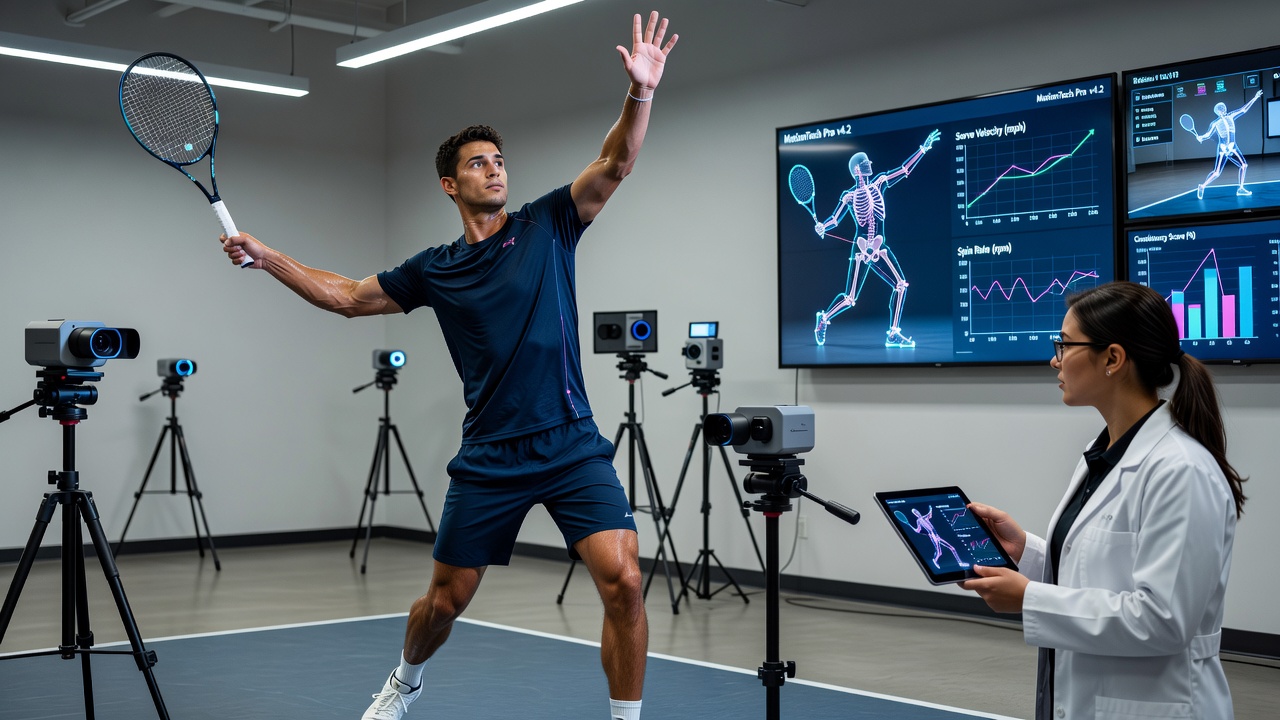
Coaches at elite training centers attach reflective markers or inertial sensors to players' arms, hips, and rackets, then record serves at 240 frames per second or higher so that software can calculate segmental sequencing and detect deviations from optimal patterns. One study conducted at a leading European sports institute found that athletes who reviewed synchronized video and numerical feedback after each set of serves reduced lateral elbow deviation by measurable margins within four weeks, and the same players maintained those corrections during match simulations because the system highlighted timing errors before fatigue set in.
Data collected during June 2026 pre-season camps showed average improvements in first-serve percentage when athletes practiced with immediate post-trial reports that compared their current trial to a personal baseline stored in the software. The loops work because players receive both visual replays and quantitative scores for parameters such as racket-head speed at contact and shoulder abduction angle, allowing them to adjust grip pressure or knee drive on the next repetition rather than waiting for coach verbal cues alone.
Applying the Same Data Streams to Quarterback Development
NFL strength and conditioning staffs have begun importing tennis-derived marker sets to analyze throwing mechanics, mapping scapular movement and pelvic rotation during drop-back and release phases. Researchers discovered that the kinetic chain demands in a tennis serve and a deep ball throw share similar peak torque requirements at the thoracic spine, so adjustments that stabilize one movement often translate when the same athlete performs the other. Several teams now run combined sessions where quarterbacks wear full-body suits while throwing to targets at varying distances, and the resulting graphs get overlaid with tennis serve templates to identify shared inefficiencies in arm slot consistency.
One documented case involved a veteran signal-caller who used the comparative analytics to shorten an exaggerated follow-through that had previously caused late-game accuracy drop-off, and the correction carried over to improved completion percentages on intermediate routes during organized team activities. The feedback loop closes when coaches load the new throwing data back into the same database used for racket sports, creating a shared library that grows with each athlete's input.
Hardware and Software Integration Across Leagues
Portable optical systems and wearable inertial measurement units now operate at sampling rates that capture both the rapid acceleration of a tennis serve and the multi-plane rotation of a football throw without requiring separate calibration routines. Software platforms merge these streams into unified dashboards that flag when an athlete's current session deviates beyond established thresholds, and training staff receive automated alerts that prompt immediate technique review rather than end-of-day analysis only. According to reports published by the Australian Institute of Sport, such integrated pipelines have supported cross-sport athlete monitoring programs since the early 2020s, and the same frameworks now appear in North American facilities preparing for teh 2026 season.
Additional validation comes from university-led projects that compared marker-based and markerless capture accuracy during live drills, confirming that both approaches yield reliable joint-center estimates when properly calibrated, and the choice between them often depends on whether the session occurs indoors or on an open practice field. The resulting datasets allow performance analysts to build individualized models that evolve with each athlete's career arc, incorporating injury history and workload metrics alongside pure kinematic variables.
Observed Outcomes in Combined Training Environments
Facilities that host both racket-sport and gridiron athletes have reported parallel gains when motion capture sessions run consecutively rather than in isolation, because the shared vocabulary around sequencing and energy transfer speeds communication between coaching groups. Players who split time between tennis and football development pathways, though rare, provide natural experiments showing that serve consistency drills can sharpen release-point repeatability in throwing, and vice versa. Figures released in mid-2026 from ongoing longitudinal tracking indicate reduced variability in key joint angles after twelve weeks of looped feedback compared with traditional video review alone, though the magnitude varies by age and prior experience level.
What's interesting is how the same sensor placement protocols developed for tennis elbow stress reduction now help flag excessive valgus loading during quarterback throws, giving medical staffs an early indicator before discomfort appears in subjective reports. The loops therefore serve dual purposes: performance refinement and load management across the two sports.
Conclusion
Motion capture technology continues to link tennis serve refinement with quarterback throwing mechanics through shared biomechanical metrics and iterative feedback systems that update in real time. As hardware becomes more accessible and software libraries expand with cross-sport data, training staffs gain additional tools for identifying and correcting movement patterns that affect both consistency on the court and accuracy on the field. The approach remains grounded in measurable kinematic outputs rather than subjective feel, and ongoing collection during the 2026 calendar will likely add further examples of how these loops operate across disciplines.